


Sorcery, as it's presented in the core rulebook of Basic RolePlaying, is actually a small subset of a much larger set of options broadly outlined in the Stormbringer and Elric! roleplaying games. For those familiar with Call of Cthulhu, which also uses sorcery, the biggest difference is the variety of offensive, defensive and utility spells available. CoC tends to view sorcery as something performed under special conditions, requiring detailed rituals and much preparation. Except for a handful of offensive and defensive spells such as the Elder Sign, most CoC spells involve contacting various Mythos entities or summoning/binding servitor races. For this reason, sorcery is a pursuit best avoided by most right-thinking characters in Call of Cthulhu, except in cases of extreme duress. And, of course, the very act of performing sorcery in CoC has a corrosive effect on one's sanity.
In BRP and Stormbringer, sorcery is more common and has no sanity implications, although the requisite POW score is prohibitive, ensuring that sorcerers are a rare breed. There are three main types of sorcery and typically, a high-level sorcerer will be adept in all three. These are spells, runes and summonings. Spells represent the default form of sorcery, the type to which most low-level sorcerers will be limited. Spells have the advantages of being quick to prepare and demanding modest power point expenditures, although durations are quite short. This is the type of sorcery used most often in combat.
Runes, as the name implies, require the preparation of an inscribed symbol which will trigger a sorcerous effect when certain conditions are met. Runes can persist for days or even years until triggered, making them useful for setting traps. Some runes duplicate the effects of spells, while others offer unique options such as wards or alarms. Most forms of Lawful sorcery are runic.
In game terms, summonings work just like spells, except they are more detailed and require greater preparation. In that respect, they are similar to Call of Cthulhu sorcery. Sorcerers can summon demons or elementals. There are also some necromantic summonings which allow a sorcerer to summon spirits to inhabit prepared corpses or even living hosts. In the latter case, the spirit of the victim is destroyed and the summoned spirit takes possession of the body. The newly-created undead is then bound to the service of the necromancer. Summoned entities are often bound, either in their living state or as the animating essence of some powerful magic item. The summoner has to spend enough power points to define the summoned creature. A fully-formed demon servant will be more costly because points will have to be spent to define physical characteristics such as STR, SIZ, CON, DEX and Move as well as POW and INT. Such a demon would require far more power points than even the most powerful sorcerer would have available. Therefore, a means of storing power points is needed to cast summonings. This requires significant preparation. Also, binding demons, elementals and undead requires the sacrifice of POW points. This is a particularly demanding requirement and one only considered by truly powerful summoners.
-Rognar-
Friday, March 25, 2011

More on allegiences
In the previous post, I talked about earning points in allegiences in order to define your character's motivations. Now I'll discuss what sorts of actions earn those points. As one might expect, it is easier to earn points for a Chaos allegience than either Law or Balance. Betrayal, wanton violence and vandalism are all ways that can potentially earn Chaos allegience points. Another way is the use of sorcery. Sorcery is inherently Chaotic, although there are a handful of Lawful spells and runes. Ironically, even the casting of Lawful sorcery can earn Chaos points, unless the sorcerer atones afterwards. A sorcerer with a Lawful allegience has to walk a fine line, using his powers reluctantly and always mindful of his allegience budget. Needless to say, demon summoning and necromancy are extremely Chaotic forms of sorcery and should never be pursued by Lawful sorcerers.
Law stresses self-discipline and respect for authority. A character with a Lawful allegience will depend on skills rather than sorcery or supernatural aid. Advancement of skills to high levels will earn Law allegience points. Other Lawful actions include obeying one's superiors and destruction of obviously Chaotic constructs such as summoned demons and animated corpses.
Balance is, perhaps, the most difficult path to follow. It demands much of its followers, including, sometimes, the ultimate sacrifice. An adherent of Balance must be merciful and a defender of the weak. He must resist both tyranny and anarchy without resorting to either. He may use sorcery as long as it serves the greater good, but must never dabble in summoning or necromancy. Any effort on the part of a character with a Balance allegience, either through the use of sorcery or skill, that prevents death and destruction will be worthy of allegience points.
-Rognar-
Wednesday, March 23, 2011
Allegiences in Weird War II
Basic RolePlaying does not use an alignment system the way Dungeons & Dragons or Pathfinder do. Rather, a character has multiple allegiences and builds up points in them depending on his actions. To use D&D as an example, the GM might decide to create five allegiences; Good, Evil, Law, Chaos and Neutrality. A character would typically start out with 1d6-2 pts. in each and then gain more points in one or more of the allegiences through the campaign. If one allegience exceeds any other by 20 pts. or more, that allegience becomes dominant and may attract the attention of powers who share that allegience. For example, a novice cleric of a lawful diety might not attract much notice from either his god or the hierarchy of his church. However, if he acts in an exemplary fashion and accumulates a lot of points for his Law allegience, he may be rewarded for his piety. Of course, if he acted in a chaotic manner and his Chaos allegience began to overshadow his Law allegience, the resulting attention he would receive would not be welcome. Furthermore, when a character reaches 100 pts. in one of his allegiences, he may be approached by a supernatural agent to recruit him to serve as a champion for some diety or similar powerful being.
In my upcoming Weird War II campaign, I will be using the Law-Balance-Chaos allegience system introduced in the Stormbringer role-playing game. Although, Good and Evil are not explicitly represented in this arrangement, it is generally accepted that the closer one gets to perfect Balance, the more "Good" characteristics one displays. Extreme Law is oppressive and hidebound, while extreme Chaos is anarchic and destructive. To illustrate this, I have created a graph showing where all the various powers in the campaign fall along the Law-Balance-Chaos axis:

As you can see, I've added a Good axis projecting from Balance. I define Good as respect for life and beauty and a capacity for self-sacrifice. Those organizations that demonstrate such qualities tend to cluster close to Balance, while the more evil and destructive organizations tend to find themselves at the chaotic or lawful ends of the scale.
-Rognar-
Monday, March 21, 2011
Miniature Painting part 2.

We had another painting party last Saturday. I finished 2 on Saturday and finished 4 more on Sunday (see next post).
Since my last painting blitz the second batch of miniatures arrived and there were some really nice ones in there. However, I decided that I wanted to try our a couple techniques and this Gray Maiden mini was a good place to start.
Somethings turned out really well. The sword looks great even though I got rather lazy with it. The detail on the shield was crazy hard and I missed some spots so lets just call it the worn look. As for the armor itself I love the way the detail pops out from the armor wash but it made everything too dark. I think I know now how to pop the detail without blacking everything out but I'll have to try it on a different piece.

With this bard I really wanted to get the hair right. Last week I discovered among my wife's vast collection of crafty stuff a bucket full of inks. Although it worked out pretty well, her inks are not the same as the other inks I have. They take hours to dry and and until they do dry they bleed into any paint that comes near them. After playing around a bit I got the color I wanted but it took too long and isn't really viable.
Nothing really special about this mini but I like the gold trim on the boots. It makes me wish I had a busty pirate wench miniature. My wife took these pictures on her fancy camera which is why they are lot nicer then the first batch. She is going to photograph the rest later and I'll post them when she does.
Lastly here is another shot of the minis I painted last time. I got tired of waiting for her to process the picture so I took my own. As you can see, she a much better photographer than I am.

Thursday, March 17, 2011
Chronicles of Future Earth....more tasty goodness
I'm happy to report that, despite my initial concerns, the first supplement for The Chronicles of Future Earth has already been released. Although only available in pdf format from Chaosium.com, The Chonicles of Future Earth - Children of the Worm is an excellent little contribution to the setting. It includes a short adventure, but the real value of the publication is the added crunch. A new race, the P'Tek (aka Troglodytes), an Esteri race of subterranean humanoids, is detailed as well as their primary diety, Babisiya, the goddess of darkness. Several cool new demon powers and spells are also provided, including necromancy spells adapted from the old Stormbringer rpg. This is hella cool for me, because I recently bought a pdf of The Bronze Grimiore from the Elric! edition of Chaosium's Elric of Melniboné rpg. This book introduced necromancy and it is excellent. Seeing at least some of that stuff showing up in Chronicles makes me even more excited about the setting.
My one beef with Children of the Worm is that it is only available as a pdf. While it is probably not long enough to be a stand-alone print publication, it has clearly been ready for some time to have been released so soon after the first book. This leads me to wonder if this was material that was intended to be part of the original setting and was later edited out in the interest of achieving a particular page count or price point. If so, it's unfortunate. I would have gladly paid a few more dollars to have this material included in the original setting book. Hopefully, sometime in the future, Children of the Worm will find its way into a print format.
-Rognar-
Tuesday, March 08, 2011
Pathfinder Gunslinger v.2
Paizo has released a revised playtest of the Gunslinger class for the upcoming Ultimate Combat release. Most of the changes seem fairly cosmetic. Notably, the class is now a base class rather than an alternate fighter class, but given how different the two classes were to begin with, it didn't seem as though the ability to alternate fighter and gunslinger levels freely was going to be very attractive anyway. The biggest change, as far I can see, is how they dealt with problem of really expensive guns in the hands of really low level characters. A 1st-level gunslinger with a 1,500 gp musket is asking for trouble. The solution the designers decided upon was to give a starting gunslinger a broken gun that only the character himself is able to use properly. To others (except those with the Gunsmithing feat who could fix the gun), the broken gun is just scrap metal. Not the most elegant solution, but probably the only way to keep guns expensive, while still allowing a low level character to own one.
Not surprisingly, the firearm rules themselves are largely unchanged. The design team made it clear with the original playtest that the firearm rules were not subject to playtest. So, the rule about guns being used against touch AC remains as do all the potential pitfalls associated with it. They have added an expanded list of guns to choose from, including advanced guns such as revolvers and rifles. While I have no problem with 15th-century matchlocks showing up in my fantasy rpgs, I'm less enamoured with the idea of 19th-century sixguns. Like everything, it's up to the DM, but I would certainly keep guns fairly low-tech in any game I was running.
-Rognar-
Monday, March 07, 2011
Rippin' on Magic: the Gathering
Zack and Steve at SomethingAwful.com have taken a break from the endless ridicule of tabletop rpgs and lay a beatdown on Magic: the Gathering. Richly deserved, in my opinion.
Magic: the Gathering
-Rognar-
Magic: the Gathering
-Rognar-
Sunday, March 06, 2011
Miniature Painting
 Derobane was nice enough to come over last weekend and while his spawn played with my spawn we did some painting. I recently put in a big order for minis and the first batch had arrived. There were a bunch I was dying to start painting.
So while DB worked on a few Nazis, I got to work on this piece. This is Eando Kline, the star of the first series of fiction in the Paizo Adventure Paths, and a key NPC in the Serpent Skull AP. I had not painted in months and this mini was pretty straight forward. I was quite happy with the face although I was kinda sloppy in a few other spots.
Derobane was kind enough to leave his painting supplies behind when he left and yesterday I ignored my wife and children and worked on a few more pieces.

This is a piece I've always liked. I can't see me ever using it for anything but there you go. I got a little experimental with this one. I thinned the paints and tried layering and it worked out pretty well. I let my wife and daughter pick out the color scheme for the outfit. The hair was a bit of an experiment that I wasn't completely satisfied with. When I do hair, it never looks quite right. I got some nice shading effects on the skin but I still have to master doing it on fabrics. Looking at the picture I can spot a mistake but I guess I should put the critical eye away and just enjoy it. This one turned out better then most.

The next Mini is another Paizo mini. This is Shalelu, elven ranger and a minor NPC in the Rise of the Rune Lords and Second Darkness APs. I tried something different again with the hair (green ink) and although it turned out darker then I wanted, it works. Overall, I thought this one turned out quite well. I'm not sure if you can see it in the picture but it looks like she has white eyeliner. Not what I was going for but it was even on both sides and I decided I liked it. I tried shading on the cape and it really didn't work. My attempt to fix it didn't go so well either. Rather then repaint the cape I just left it as is. If I wanted perfection I'd never finish.

The last one is the Red Mantis Assassin, another Paizo mini. I really like how the ink was able to pop the detail on the armor but it made the red a little darker then I intended. Still how many assassins would walk around in bright red armor, right?
I also spent about an hour yesterday gluing the minis with multiple pieces together. My least favorite thing about painting the miniatures is assembling them. I have no patience for it. I only got the epoxy working once and that was after Derobane told me his trick (mix and let it start to dry before applying). I tried Crazy Glu yesterday I still had to hold one piece for 15 minute before it set (getting evil looks from my wife the whole time since it was supper time). Everything is assembled now and maybe next weekend I'll consider painting some of those ones as well. Seltyiel has some crazy detail work including a fiery familiar. On second though I'll save him until I get better.
Monday, February 28, 2011
Chthonian Stars and Traveller, not totally dead
Wildfire has finally made the announcement on the future of Chthonian Stars and it is not a total loss for those of us who looked forward to the game being available for the Traveller rule system.
Chthonian Stars Set For Release!
Fans have been eagerly awaiting the release of Chthonian Stars: the Cthulhu Saga I, an original Lovecraftian sci-fi/horror setting for the classic Traveller roleplaying game. This project was to be published by Mongoose Publishing, though developed by WildFire, the team that created the award-winning CthulhuTech. Over the last month, these two companies have agreed to part ways.
There's good news for Traveller fans, however, as WildFire will be releasing both the Chthonian Stars Core Setting and the Horrors of the Void monster books as PDF's on DriveThru RPG – with the option for physical copies through OneBookShelf's new print-on-demand program. The Core Setting is scheduled to be released in April 2011, as originally planned, with Horrors of the Void following in June 2011.
On the other hand, WildFire will be taking Chthonian Stars in its own new direction, starting in June 2011. Through their partnership with Sandstorm Productions, WildFire will be re-tooling the product for proprietary release. The brand new Chthonian Stars will likely see a name change, and be home to a brand new system. The entire product will have a focus on accessibility, making it easy for new players to pick up and play the game.
The new Chthonian Stars Core Book will be available as a complete roleplaying book in June 2011, through standard distribution and retail. The revised Horrors of the Void monster book will be available as the first supplement in September. The rest of the line will follow in 2012, starting in January.
Details about these books final sizes, page counts, and price points will be available as they are solicited.
The pdf releases of the core book and the first supplement are welcome concessions to us Traveller fans. Beyond that, there is no mention of Framewerk, so I will give the game a look. Hopefully, they will use a system I am already familiar with, but if it's FATE or Savage Worlds, I'll have to give it a pass.
-Rognar-
Thursday, February 24, 2011
Movement rates in BRP need repair
I've started disassembling the Basic RolePlaying rules in anticipation of my upcoming campaign with an eye toward establishing any quirky bits that will grate on my OCD tendencies if not fixed. Some can be dealt with using various optional rules (of which, BRP is amply endowed), but some require house ruling. The first is movement rates. A fit, unencumbered human is expected to be able to move 30 metres in a 12 second combat round, assuming he is performing no other actions. This is a movement rate of 2.5 m/s (5.6 mph) and is represented by a MOV characteristic of 10. A top sprinter can move four times as fast, but we're not talking about a world-class athlete under ideal conditions, so I accept that movement rate to be reasonable. However, once you start looking at the MOV rates of other things in the game, it goes off the rails a bit. For example, two things I'm interested in for my campaign are horses and tanks. A horse has MOV 12 which corresponds to a movement rate of 3.0 m/s (6.7 mph). Now I know horses aren't the most sure-footed of beasts and their size means they need a few seconds to get going, but an average horse can run about 25 mph (to say nothing of a thoroughbred). So, even if you cut their speed in half, they should still have a movement rate twice that listed. Incidentally, all the other large mammals listed in the BRP core book have the same MOV 12 (or less) save one, the bear, which has MOV 14.
Things really get wobbly when you look at vehicles. A "vintage" tank is described as a WWI-era tank and has MOV 42. This works out to 10.5 m/s (23.5 mph). Yet, the fastest tank of WWI, the British Medium Mark A Whippet, had a top speed of 8.3 mph. The blinding speed of the vintage tank is closer to a Panzer IV which has a top road speed of 26 mph, but even the Panzer IV could only manage about 10 mph off-road.
Based on this analysis, I would suggest the following changes. A human MOV 10 serves as a baseline for a speed of about 6 mph. A horse can sprint about 12 mph, so it will have MOV 20. A WWII-era tank such as a Panzer IV or a Sherman can move about 18 mph if we simplify things and average its road and off-road speeds, giving it a MOV 30.
-Rognar-
Wednesday, February 23, 2011
Rippin' on...Heroes Unlimited
Is there any rpg-related pastime more enjoyable to the unwashed masses than mocking all things Palladium? Zack and Steve take on Heroes Unlimited. Even the URL is funny.
Heroes Unlimited
-Rognar-
Heroes Unlimited
-Rognar-
2011...where's the cool?
A few months ago, 2011 seemed like it would be another year of exciting new releases from several companies that would easily consume my monthly budget for entertainment all year long. Unfortunately, my enthusiasm has really taken a beating lately. Sure, there have been some good products out already, namely The Chronicles of Future Earth by Chaosium and Traveller Supplement 8: Cybernetics by Mongoose, but it looks like things could be getting a bit sparse from here on.
We've had two playtests for Pathfinder Ultimate Magic and one for Pathfinder Ultimate Combat and, at this point, I have to say my enthusiasm for those upcoming releases is not high. No doubt, I will still buy them and I hold out hope that the design team will find a way to make firearms awesome in Pathfinder, but right now, I am not exactly counting the days until the release of those books. The other project I've been looking forward to seems to have gone completely off the rails, that being Chthonian Stars by Wildfire. Originally intended to be published by Mongoose using the Traveller game system, that plan has been terminated. We currently await an announcement from Wildfire about the future of the game. We do have confirmation that there are still plans to release it in a dead tree format, but speculation is that Wildfire will publish it (or maybe Sandstorm, the publishing house of CthulhuTech, Wildfire's other rpg), using their own Framewerk game engine. I can see why they would want to support their own rules, but I really don't like the system with its rather gimmicky dice-rolling mechanics. If it turns out that Chthonian Stars does end up using Framewerk, I think that would be a dealbreaker for me.
Combine all that with the end of Dungeons and Dragons Miniatures and AT-43 and 2011 looks like a lean year for me. On the plus side, it means more money in my pocket.
-Rognar-
Thursday, February 10, 2011
Rippin' on...Space: 1889
I remember back when GDW released the original Space: 1889 game, one of the guys in my gaming group bought it. For some reason, we never tried it out. Too bad, it looks like we missed out. Zack and Steve at SomethingAwful.com have some fun at GDW's expense.
Space: 1889
-Rognar-
Space: 1889
-Rognar-
Friday, February 04, 2011
Wildfire and Mongoose, a match made in Hell
Why is it that Wildfire and Mongoose simply cannot work together to produce a worthwhile product? Mongoose, as you may recall, was the original publisher of CthulhuTech, Wildfire's signature property. I had the misfortune of buying the original core book from Mongoose. It fell to pieces in under 24 hours. I was able to get a sturdier replacement, but it was not long before the Wildfire-Mongoose collaboration fell apart and Wildfire jumped over to Catalyst Game Labs (an even bigger disaster, Cthulhu clearly hates this game). Anyway, when Wildfire came up with its second rpg property, Chthonian Stars, they decided to renew old acquaintances with Mongoose. The game was originally going to be released in Q4 2010. It got pushed back to Q2 2011. Now it appears it won't be released at all, at least not as a dead tree Mongoose product (see here and here). Hopefully, Chthonian Stars will still see the light of day, but it won't be from Mongoose.
-Rognar-
-Rognar-
Sunday, January 30, 2011
Chronicles of Future Earth - mine at last

The wait was a bit longer than I'd hoped, but The Chronicles of Future Earth finally arrived at my FLGS and I eagerly bought myself a copy. It's a 112 pg. softcover with a removable double-sided, two pg. map of the city and the province that comprise the setting (more on that in a moment). Chronicles, written by Sarah Newton, author of the Mindjammer campaign setting for Starblazer Adventures, describes the territory of southern and central Spain as it might be a hundred thousand years in the future. The province of Korduva (modern-day Cordoba) is the northernmost territory of a great, but decaying empire called the Venerable Autocracy of Sakara spanning what is now North Africa (Sakara = Sahara, perhaps). Just to the north of Korduva is the Amadorad (modern-day Madrid) Protectorate, a vassal state and ally of Korduva against the Chaos Wastes which lie further to the north. The world of Chronicles is strange, depleted and decadent. Dozens of races, some human, some near-human and some decidedly non-human struggle to survive in a world haunted by summoned demons and creatures of chaos. The Gods are real and their temples are sources of magical power. Employing ancient technologies such as gravity cannons and force blades along with powerful sorcery and simple spears and shields, the peoples of the future earth defend the remnants of civilization from the horrors that wait Beyond the Veil.
Chronicles of Future Earth begins with a chapter on races and cultures. There are very brief descriptions provided for a couple of dozen races, human, humanoid (Jeniri, the "Cousins of Man") and non-human (Esteri, "Not-People of Urth"). Of these, four races are given detailed descriptions for use as player races. Two of these are human, the Hivernians and the Amadoradi. The former are the people of Korduva [and the neighbouring province of Elikan (modern-day Alicante)], civilized citizens of the Venerable Autocracy, while the latter are the people of Amadorad, hard, militant folk only recently brought into the imperial fold and still chafing under the yoke of civilization. The third race are the Virikki, a Jeniri race of blue-skinned scalyfolk with powerful psychic abilities and a refined aesthetic sense. Finally, there are the Hsun (or Spider Folk), an Esteri race of large arachnoids known for their skillful artifice and their ability to produce alagin, a hard substance used instead of metal (which is rare and expensive).
The next two chapters, detailing character generation and divine powers and demon summoning respectively, serve to adapt the Basic RolePlaying game system to the setting. The details on summoning and using demons are particularly welcome as I always thought the rules outlined in BRP were a tad sparse and unclear in this regard. After that is a chapter on the Gods of the Great Compact, powerful extradimensional beings who united in the distant past to defeat an evil entity known as the Great Hegemonist. Two in particular, Regos, the god of rulership and conquest, and Vareltias, the god of diplomacy and trade, are described in detail such that their temples can be used as patrons or sources of spells. A chapter on artifacts and equipment, another brief chapter on the city of Korduva and a bestiary follow.
Lastly, there is a sizable introductory adventure included which incorporates pretty much everything that is detailed in the rest of the book. It ties everything together quite nicely and provides a pretty good feel for the setting. Other features include the aforementioned map of the city of Korduva and the territory of Hivernia, a handy glossary, a complete index (though no table of contents) and an appendix for various tables and maps.
I really can't find much to criticize in this book. The artwork is black-and-white throughout, but it's quite well-drawn and appropriate (although a couple of images are used more than once). My only concern might be the limited scope of the book. Many things are described briefly, but not to an extent that they could be readily incorporated into an ongoing campaign. This wouldn't be a problem if further supplements were to be released in a timely fashion, but it would not be unfair, I think, to describe Chaosium's publication schedule as glacial. Thus, it could be many months before we get to see the next installment in this excellent campaign setting. I hope Chaosium realizes what a gem they have in Chronicles and proceeds to quickly get some new content into the pipeline.
-Rognar-
Thursday, January 27, 2011
Firearms in Pathfinder
With a growing sense among the Pathfinder community that the new firearms rules are going to be a mess, it got me to wondering how guns could be incorporated into the game some other way. One simple option that has been used before is the exploding dice mechanic. Roll 1d8 for damage, if you roll an 8, roll again. Repeat as necessary. It's simple enough if you just have one type of gun, but what happens if you have a pistol that does 1d6 and a musket that does 1d8? You actually have a better chance of exploding your die and, thereby, rolling more damage with the smaller weapon. You could do a dice pool approach, a pistol does 1d6 and a musket does 2d6. Any sixes are exploded.
This approach is functional, but I find it inelegant, largely because it is an exception to the normal combat rules. I think a better approach is to take armour out of the AC business altogether and make it all about DR. Give characters a defense value equal to 1/2 BAB. All AC modifiers other than armour and natural armour, but including shields would be added to the defense value. Then, make another type of damage, called ballistic, which would plug into the DR rules just as slashing, piercing and bludgeoning already do. As an example, take leather armour. Instead of +2 AC bonus, give it DR: 1/ballistic. Magical leather might be DR: 2/ballistic. I would want heavier armour types such as plate or dragon scale to have some DR against firearms, so full plate would be something like DR:5/ballistic and 2/- (no stacking). Monsters would also have this. A creature with a natural armour
would, instead, get DR similar to armour of comparable AC bonus. I think natural DR (such as that granted to the barbarian class) should stack with DR granted by armour, which, I concede, is an exception to the general rule on DR, but I think it's an exception worth including.
So what do you all think about this?
-Rognar-
More thoughts on the Gunslinger
After reading much of the discussion on the Paizo messageboards, I have come to conclude that my initial enthusiasm for the gunslinger class and the firearms rules in general was unfounded. I have been convinced that there are serious problems which I did not initially consider. First of all, giving guns touch attack capability is really going to mess up any sense of realism. While it is true that in the real world, guns largely rendered armour obsolete, this is not necessarily realistic in a fantasy world. I mentioned in my previous post the problem of adamantine armour, but we also have to consider magic and, for that matter, natural armour such as dragon hide. Should a primitive, non-magical firearm be permitted to ignore the natural armour of an ancient red dragon? Heck, many modern firearms can't reliably penetrate the hide of an elephant or rhino, let alone a dragon. No doubt, there will be some new magic armour quality included in Ultimate Combat which will negate the touch attack ability of firearms, but that doesn't help the dragons and other thick-skinned monsters out there.
The other concern is the economics of the gunslinger. A 1st-level gunslingers starts out with either a musket or two pistols as well as 50 bullets and sufficient black powder to fire them for free. This is roughly 2000 to 2500 gps worth of treasure, giving a 1st-level gunslinger the highest treasure/CR ratio of any monster in the game. What is going to stop a group of players from wandering the country hunting down low-level gunslingers to collect their extremely valuable guns? And low-level PC gunslingers will have massive bullseyes painted on their backs. They will become walking ATMs.
The Pathfinder design team still has a lot of work to do on this one.
-Rognar-
Wednesday, January 26, 2011
New Pathfinder playtest - the Gunslinger
Paizo has come out with the first playtest for the upcoming Ultimate Combat splatbook for Pathfinder. The pdf includes three new classes, the ninja, the samurai and the gunslinger, as well as new combat rules for firearms. I don't really have much to say about the ninja and the samurai. We've seen those classes done numerous times before and my only response to yet another incarnation is profound indifference. However, I'm very interested in incorporating blackpowder weapons into my games, so I was more than a little curious to see what Paizo had in store for us.
First off, I'll get it out front. I hate the name of the "gunslinger" class. I would have preferred something like "fusilier" or "arquebusier". For that matter, given the sort of swashbuckler character this class seems designed to create, the name "musketeer" might even be appropriate. The primary class feature of the gunslinger is Grit, a pool of points the character can draw from to execute various daring maneuvers or shooting tricks. It ends with the inevitable True Grit capstone ability which ties in with the name of the class. Still, the iconic image included in the pdf is far more reminiscent of Capt. Jack Sparrow than Rooster Cogburn, so there seems to be a bit of confusion as to what cultural icon (with an avian name) the designers were going for here. Yet, despite the aggravation caused by the Wild West terminology used, the class itself seems decent enough. I doubt most gunslingers in the game will concentrate solely on their guns, given the limitations of those weapons (which I will discuss below), but a gunslinger with a handy rapier at the ready would be a formidable combatant.
Even more than the gunslinger class, I was interested in reading the firearm combat rules. D&D has always had a problem with guns, because of the nature of the armour class rules. Guns are inevitably inferior to bows unless some way of incorporating armour penetration exists in the game system. Some d20 games have done a good job of dealing with this, most notably True20 by Green Ronin, by introducing a new saving throw, called Toughness, which represents a character's ability to avoid damage. The armour bonus adds directly to the Toughness save, rather than the Defensive Modifier (the character's ability to avoid being hit). Likewise, the attacker's weapon adds a modifier to the DC of the save, with firearms generally having higher modifers than more primitive weapons. This approach, however, requires wholesale changes to the game mechanics, since True20 uses a damage track, rather than hit points. The Paizo design team is using a simpler approach to model firearms. Attacks within the first range bracket are touch attacks. Why didn't I think of that? It's so obvious now. No fiddling with DR, just turn off armour altogether versus guns at close range. A few people might have a problem with it, because it means even adamantine armour won't stop a bullet, but that could be house-ruled easy enough. Just increase the cost of adamantine to reflect its added advantage and say that guns don't get touch attacks against adamantine armour. You could then add adamantine bullets to get the touch attack ability back.
Now guns do still have disadvantages, notably the rate of fire, though how much of a disadvantage that will ultimately be is a bit hard to tell right now since only the most basic firearms rules are included. It's possible that feats and magic options may appear in the final product which can mitigate the problem. Another problem I see is the cost of ammo. One shot of black powder costs 10gp and a single bullet costs 1gp, so it's going to cost 11gp per attack. Contrast that with 20 arrows or 10 heavy crossbow bolts for 1gp. Conserving ammo and using a backup weapon whenever possible is going to be the order of the day for gunslinger PCs. Nonetheless, I can't wait to try out my first gun-wielding character.
-Rognar-
Update: One more comment about the Gunslinger. It has a class feature called Brave and Tough which provides bonuses to both Fortitude and Will saves. The Reflex save is the good save for the class, but with the bonuses provided, Fort and Will never fall less than one point below Ref, giving the gunslinger almost monk-like saving throws. This is quite a major advantage that might be easily overlooked.
Further Update: Upon further perusal, I notice it is possible for a gunslinger to use grit points and the Lightning Reload Deed feat to reload as a free action. This doesn't really mitigate the rate of fire problem though, since grit points are not typically abundant. Still, it's good to have when you really need it.
Thursday, January 20, 2011
Rippin' on...Rifts Canada
About time the Great White North got to enjoy some of the derision. Zack and Steve take on Rifts: Canada.
Rifts: Canada
-Rognar-
Rifts: Canada
-Rognar-
Wednesday, January 19, 2011
Is Pathfinder no.1?
It is according to Ryan Dancey, former D&D brand manager at WotC and the individual most responsible for the OGL. In his most recent column at EN World, Mr. Dancey had this to say:
Pathfinder from Paizo couldn’t exist without the OGL and the D20 System Reference Document. And according to my industry sources, it’s outselling Dungeons & Dragons a feat (no pun intended) I would have considered almost impossible 10 years ago.
This has to be considered amazing news to those of us who play Pathfinder, as well as vindication considering all the abuse heaped upon us by the 4e fans on one side and the OSR folks (not all, but some of the more opinionated) on the other. D&D 3.x/Pathfinder, I believe, hits just the right demographic sweet spot. It doesn't appeal much to the greybeards of the OSR (although my beard is certainly greying, I feel little nostalgia for "old-school" D&D) and it takes too much "like thinking and stuff" for the kids, but the 30- and 40-year-olds who played back in high school and are now married with families, it's a perfect fit.
-Rognar-
Monday, January 17, 2011
The future of D&D, my 2 cents
Everyone with a blog and an interest in tabletop rpgs has put forth their speculations on what the recent moves by Wizards of the Coast mean. It seems only right that I should too. Like many, I agree that big changes are coming to the venerable old game. D&D as we oldtimey guys remember it is about to disappear. I see two models of D&D coming out of the restructuring, the "World of Warcraft" model and the "Magic: the Gathering" model. I think we will see a D&D MMO in the near future. How that affects the whole Atari computer game licensing issue is not clear to me as I have absolutely zero interest in the legal shenanigans going on between Hasbro and Atari, but I am sure it will eventually happen.
The second model is a little less clear. After all, it's unlikely WotC wants a M:tG clone to directly compete with its flagship property, so a D&D CCG would have to be different in some way. Maybe they could combine a board game with a CCG. The new fortune cards seem to be a nod in that direction. Alternatively, the D&D cards could be part of a Virtual Tabletop game. Your "character" would be a deck of cards, each of which would have a code number. You could input the number into your online account to create a bank of options for your character. It's possible you could simply buy decks online, but I think many customers would be suspicious of purely online cards. Besides, I think WotC still wants the D&D brand to appear, in some form, on store shelves. Nonetheless, I think the days of hardcover rulebooks and sweaty nerds gathered around a table in the basement playing D&D are coming to a close.
Of course, there's always Pathfinder, Labyrinth Lord, True 20, RuneQuest II, Warhammer Fantasy Roleplay, Fantasy Craft, Castles and Crusades, Earthdawn, OSRIC, Palladium, HARP.....
-Rognar-
Thursday, January 13, 2011
And so, it ends...
My last link with Wizards of the Coast has been severed. They ended my D&D addiction with the release of 4e, they ended my Star Wars addiction with the termination of the Star Wars licensing arrangement for Star Wars Saga Edition and the miniatures line, they ended my Axis & Allies addiction through declining quality and simple neglect of that miniatures line and now, from the January Ampersand article, this:
We have made the decision to depart from prepainted plastic miniatures sets. Lords of Madness stands as the final release under that model. We will continue to release special collector’s sets (such as the Beholder Collector’s Set we released last fall), as well as make use of plastic figures in other product offerings. Check out the Wrath of Ashardalon board game next month for the latest example of this. Moving forward, we will continue to explore more options for players to represent characters and monsters on the tabletop, including Monster Vault and other D&D products that feature monster and character tokens.
Perhaps it's fitting that 2011 is the 30th anniversary of the first time I opened a D&D book. It has been a wonderful relationship, but all good things must come to an end.
-Rognar-
Wednesday, January 12, 2011
A tale of two monster manuals
I have recently acquired two monster books, the Pathfinder Bestiary 2 and the RuneQuest II Monster Coliseum, so it seems like a good opportunity to compare and contrast the products of two mid-sized tabletop rpg publishers, Paizo and Mongoose. Both books are hard-cover and both cost the same at $39.99 US (which given the current exchange rate, works out to pretty close to the same price in Canada). The RQIIMC weighs in at a decent 184 pgs. with an attractive faux-leather cover, while the PRPGB2 is a hefty 320 pgs. with a splashy cover featuring an original work by Wayne Reynolds. Production values clearly favour Paizo, with high-gloss paper and full-colour art work throughout, although my personal taste favours the exterior of the RuneQuest II series of books. I may be a bit old-fashioned, but I've always been partial to musty old leather-bound books. They hold the promise of arcane knowledge that a splashy coffee-table book never could.
As for contents, well, I have to cut Paizo some slack since this is their second bestiary and most the truly iconic monsters were already presented in the first bestiary. I have recently commented on the inclusion of classic Cthulhu Mythos monsters in the Pathfinder bestiaries and I believe this is the best thing about the new release. In the first bestiary, we had the Shoggoth, but in PRPGB2, we have the Shantak, the Leng Spider, the Denizen of Leng, the Gug, the Serpentfolk and the Hound of Tindalos. Beyond that, some of the interesting new addditions include the Chupacabra, the insanely-powerful Jabberwock and Scylla and Carybdis. Of course, with any collection of monsters, there are going to be some you can really do without. For me, the real stinkers are the primal dragons and the new elementals. I never cared much for crystal dragons and para-elementals back in the good old days and I am no more enamoured with them now. Still, there's a lot to like in here, especially if you like to use extraplanar creatures
The RQIIMC is a bit different in that it maintains a theme of gladiatorial combat throughout in addition to the descriptions of the monsters. Each stat block includes advice on how to use each monster in the arena. In some cases, magical control is needed and a few monsters are deemed totally unsuited to blood sports. Another theme of the book is the use of the Glorantha campaign setting with RuneQuest II. Some Gloranthan races, notably elves and dwarves, are significantly different from the Tolkienesque versions we are more familiar with. Gloranthan elves, for instance, more closely resemble treants than humanoids. So, stat blocks are included for both Gloranthan and traditional fantasy versions of some races. Despite its dark fantasy reputation, the Glorantha setting seems to contribute more whimsy than grittiness, from the silliness of the Ducks (and their gladiator hero, Quacktacus...for real!) to the utter ridiculousness of the Jack-O-Bear (yeah, a bear with the head of a jack-o-lantern). Fortunately, such foolishness is not the norm and much of what's presented is quite good.
Overall, I'd have to give the nod to Paizo for value-for-money, but both books are very useful additions to their respective games.
-Rognar-
Friday, January 07, 2011
Rippin' on...Werewolf: The Apocalypse
Zack and Steve have once again got White Wolf in their sights, but this time they're hunting werewolves.
Werewolf: The Apocalypse
-Rognar-
Werewolf: The Apocalypse
-Rognar-
New campaign wiki
For those who will be participating in my new BRP Weird War II campaign (and for those interested onlookers), I have started a campaign wiki entitled "Tommies at the Gates of Hell". You can find the link in the link list on this page. The introduction has been posted and more information will come soon.
-Rognar-
-Rognar-
Tuesday, January 04, 2011
My gaming wishes for 2011
As I look ahead to the new year, I find myself feeling unusually optimistic. The price of oil is on the rise and while that is typically not viewed as a particularly positive development in most of the world, here in Alberta, it's good news...up to a point. Aside from the general benefit that all Albertans derive from oil revenue, several guys in our gaming group actually work for oil companies, so the continued financial well-being of the oilpatch is good news for us. And to folks back east paying upwards of $1.20 per litre for gasoline, well sorry about that, but at least we'll be able to keep up the billions in equalization payments, so it's a win-win.
As for my wishes for 2011, I hope we'll see some stabilization of the situation in Afghanistan, so we can begin bringing our troops home with honour. I hope the global economy starts showing signs of improvement. We could all use some good news on that front.
On to my gaming wishes, I hope Rackham Entertainment is able to survive its current financial problems or that a buyer can be found for the AT-43 and Confrontation miniatures lines so they will be revived. I hope for another good year for Paizo, as I anxiously await the release of Pathfinder Bestiary 2 and Ultimate Magic. I hope for an improvement in the fortunes of Chaosium with the release of Chronicles of Future Earth. It looks excellent and if there is something Chaosium needs badly, it is a successful campaign setting for Basic RolePlaying. I'll also be rooting for Mongoose and the guys at Wildfire to have a big success with Chthonian Stars. Release delays are not a good sign, but hopefully the extra few months will make it that much more awesome than I'm sure it already was. Finally, I hope for good success for Wizards of the Coast. Although I find I rarely buy much from them anymore (except for some minis now and then), they are the industry leaders and their success is good for everybody.
-Rognar-
Monday, January 03, 2011
The Christmas haul of 2010
It was a good year around the Rognar household this past year and that was reflected in the mountain of Chinese-made plastic piled up under the Christmas tree. Of course, not all the toys were for the yard apes. Daddy had an impressive haul as well.

Displayed above are:
Traveller Book:9 Robots
RuneQuest II: Monster Coliseum
AT-43 Red Blok Dotch Yaga
AT-43 Therians Omega Tiamat
AT-43 Operation Damocles Boxed Set
AT-43 Oni Virus Zombie Detonator
AT-43 Cogs Warmongers
Confrontation Griffin Army Fusiliers
Confrontation Griffin Army Demon Hunters
Confrontation Griffin Army Cannon
Confrontation Scorpion Army Crossbowmen
I will review the books at a later date, but at first glance, both look excellent. Heartfelt thanks to all the family members (and especially Mrs. Rognar) who made my cup runneth over.
-Rognar-
Saturday, January 01, 2011
Clash of the Titans - better than expected
I avoided the recent remake of "Clash of the Titans" when it was released in theatres because of early bad press, both from critics and from the fans. Most of the criticism seemed to stem from the lousy 3D effects, although the movie was panned pretty generally. I finally got around to watching it on DVD the other night, obviously in its intended 2D format and I must say, it is actually a pretty enjoyable flick. True, Sam Worthington is not a very convincing Greek hero, but the action was tight and the story was very reminiscent of my early gaming experience. This is, ultimately, the purpose of this post. Unlike many gamers whose original pen-and-paper role-playing experiences date back to the early 80s, I have never felt all that much influence from the sword-and-sorcery genre. Sure, I read some Conan stories and my D&D characters always insisted on a fair share of the loot, but the thought of playing a thief or adventuring solely for personal gain never occurred to me. My characters were always heroes, like Perseus or Gandalf or Beowulf, defending the weak and fighting evil. The story of Perseus, leading a small band of heroes on a perilous journey to uncover a means of defeating the Kraken and saving Argos was not just an entertaining story for me, it was a nostalgic reminder of youthful fantasies.
Also, riding giant scorpions, that's Metal!
-Rognar-
Also, riding giant scorpions, that's Metal!
-Rognar-
Saturday, December 25, 2010
The Witcher - The Last Wish
So now that life has geared down a bit for the holidays I've had a chance to do some reading. Strolling around the mall the other day while waiting for new passports photos I pushed my way into Indigo books and took a look around. I really hadn't intended on buying anything but a couple books caught my eye so I picked them up.
The first book is The Last Wish. I written by a Polish best selling author and only translated into English a couple years ago. Its not a tough read and I tore through it in 3 nights. The tale is really a collection of short stories connected through a meta story that separates each part.
The witcher is a monster hunter, a human who was taken as a child and subjected to various experiments that makes him faster, stronger, and heal quicker than regular humans as well as see in the dark. Geralt, the protagonist, withstood the experiments better then most and so was subjected to more which left his with no skin or hair pigmentation.
The world itself is either heavily influenced by D&D or they share many common sources. The book has a rather dark sense of humor and most of the short stories are twists on fairy tales. One thing I really like about the setting is that magic is somewhat, well magical. In D&D, everyone (the players anyway) know what magic is and what it can do. In this world, magic is much more mysterious and there is always a great deal grey. There is no black and white clearly defined rule sets. For example, a mad wizard proclaimed that all princesses born after an eclipse would be cursed with evil. So all of these princesses were locked in towers (because killing them would be inhumane). Unfortunately there was a period where it became fashionable for princes to rescue these maidens. The rescued princesses then sought out revenge on the wizard who locked them up, which the wizards used as proof the women are evil.
There are lots of clever twists on the genre and the book is a worth while read. The witcher makes me want to try out the new magus class that is being play tested by Paizo. Very similar flavor.
Friday, December 24, 2010
Merry Christmas to all...
...and may 2011 bring you all plenty of natural 20s, both at the table and in the real world.
-Rognar-
-Rognar-
Thursday, December 23, 2010
Tuesday, December 21, 2010
Demons need more Chaos
Look at this picture:

Now tell me quickly, are they demons or devils? If you are a true D&D/Pathfinder aficionado, you probably recognized them as demons. But they don't really look all that different from devils. You could easily file the serial numbers off that Hezrou and turn it into some new kind of devil. Think about that, the very essence of Lawful Evil and Chaotic Evil are virtually indistinguishable. This has never sat right with me. Demons are supernatural Chaos in its vilest form. They aren't merely superpowerful orcs, they are pure Chaos and pure Evil.
Now, the Evil part is fine. They slaughter the innocent, they corrupt the powerful and they destroy beauty and goodness whenever they can. However, the Chaos part just doesn't come through. One Vrock is pretty much indistinguishable from every other Vrock. If they were truly Chaotic (as opposed to chaotic), every demon should be unique and constantly changing. They should constantly be growing and losing new limbs, developing new abilities while losing others. The Babau you are fighting this round should suddenly morph into a Nalfeshnee next round and then a Dretch after that. What we really need is a random demon generator. Maybe it's too much work for the DM, especially if demons figure prominently in his campaign, or maybe such a system doesn't work well with an exception-based system like Pathfinder. It is something I've been thinking about trying for awhile, so I guess I will find out eventually.
-Rognar-
Tuesday, December 14, 2010
An AT-43 Christmas for me
With the demise of Rackham Entertainment back in October, the race is on to grab up the remaining stock of AT-43 and Confrontation pre-painted miniatures. Supplies are already dwindling at our FLGS, so I have decided to do a little proactive Christmas shopping. There will be a lot of Red Blok and Therians under my tree this year. I even managed to score one of these:

and one of these:

And guys, you better get down there soon if you want to snatch up some Confrontation minis before they're all gone.
-Rognar-
Cross-posted at Rognar's Space Horror RPG Blog

and one of these:

And guys, you better get down there soon if you want to snatch up some Confrontation minis before they're all gone.
-Rognar-
Cross-posted at Rognar's Space Horror RPG Blog
Friday, December 10, 2010
Rippin' on...Vampire: The Masquerade
Zack and Steve blast ichthyoids in a cask as they mock the artwork of Vampire: The Masquerade.
Vampire: The Masquerade
-Rognar-
Vampire: The Masquerade
-Rognar-
Thursday, December 09, 2010
Pathfinder Bestiary 2 - more love for the Mythos
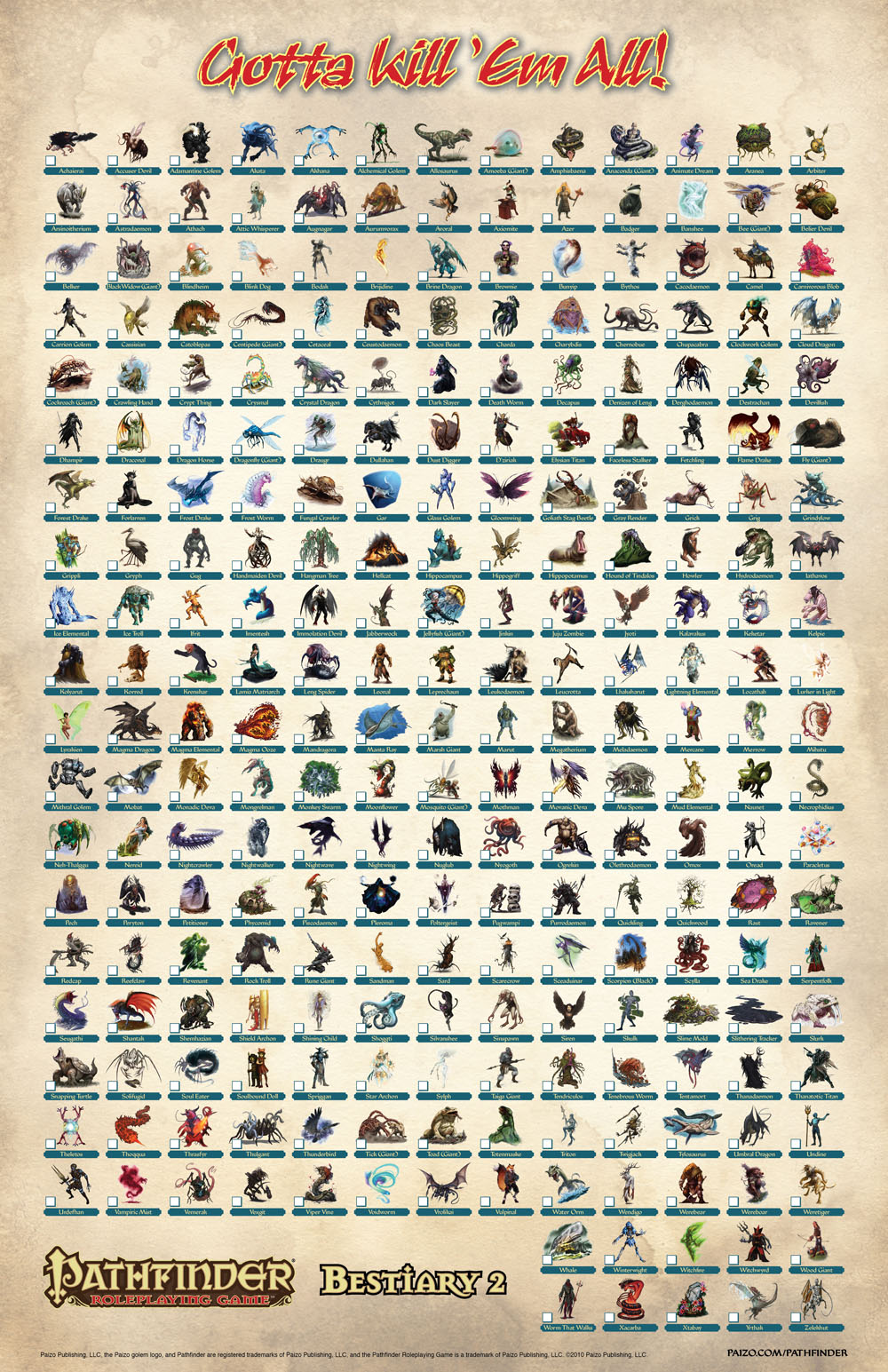
I was bouncing off the walls when I first noticed the Pathfinder Bestiary had an entry for the Shoggoth. So, I have been anxiously awaiting the release of the Pathfinder Bestiary 2 due for release early in 2011, in hopes that more Cthulhuesque goodness will be included. Imagine my joy upon seeing Paizo's new poster showing all the monsters that will be included. Not one, not two, but no less than four Cthulhu Mythos creatures will make an appearance. Of those, three, the Hound of Tindalos, the Gug and the Leng Spider are classic Mythos monsters. The fourth one, the Denizen of Leng, is unfamiliar to me, but the name clearly points to a Mythos origin. A fifth one, the Wendigo, is also found in the Call of Cthulhu game, but it is a creature derived from Native American mythology and therefore, the Pathfinder version may not necessarily resemble the Cthulhu Mythos version. A sixth one, the Serpentfolk, may be the Serpent People of the Mythos, or may be something else, like the Yuan-ti perhaps. Lastly, there is the Worm that Walks. This one is found all over the place including the Age of Worms adventure path, but it too, has a Lovecraftian heritage. Recall from Lovecraft's The Festival:
Wisely did Ibn Schacabao say, that happy is the tomb where no wizard hath lain, and happy the town at night whose wizards are all ashes. For it is of old rumour that the soul of the devil-bought hastes not from his charnel clay, but fats and instructs the very worm that gnaws; till out of corruption horrid life springs, and the dull scavengers of earth wax crafty to vex it and swell monstrous to plague it. Great holes secretly are digged where earth's pores ought to suffice, and things have learnt to walk that ought to crawl.
-Rognar-
Wisely did Ibn Schacabao say, that happy is the tomb where no wizard hath lain, and happy the town at night whose wizards are all ashes. For it is of old rumour that the soul of the devil-bought hastes not from his charnel clay, but fats and instructs the very worm that gnaws; till out of corruption horrid life springs, and the dull scavengers of earth wax crafty to vex it and swell monstrous to plague it. Great holes secretly are digged where earth's pores ought to suffice, and things have learnt to walk that ought to crawl.
-Rognar-
Wednesday, December 08, 2010
Barsoom + d20 Modern = Cool!

Adamant Entertainment recently had a sale on DriveThruRPG in which they were selling pdfs of some of their titles for one freakin' dollar! Normally, I wouldn't give any of their publications a second glance, but hey, one freakin' dollar! Now, Adamant Entertainment is best known for their ICONS superhero game, but my interest in the supers genre is so low that even one freakin' dollar is too much to pay, but I did notice another of their games, namely Mars, a sword-and-planet game loosely based on the "Barsoom" stories of Edgar Rice Burroughs. I confess I've never read any of the Barsoom stories. Truth be told, I've never been a fan of the "planetary romance" style of pulp sci-fi, having cut my teeth on the works of Heinlein, Asimov, Clarke and Herbert, rather than Burroughs, Brackett and Howard. Lately, however, I've become a bit more interested in all that creaky old stuff, having become creaky and old myself. Besides, it was one freakin' dollar!
Mars uses the d20 Modern game system, one of my favourites. Damn, why didn't someone tell me about this earlier? There are six races, Red Men (civilized, native Martians), Green Men (savage, orc-like barbarians), White Apes (intelligent, war-like gorillas), Grey Men (not men at all, but rather octopoids), Synthe Men (androids) and Earthmen (humans from Earth transplanted on Mars). Most PCs will be Red Men and Earthmen, although PC White Apes and Green Men are also possible. Synthe Men and especially Grey Men do not make suitable player characters. Most everything in the rules is taken straight from d20 Modern except for how they treat the Defense Value, which is handled in a clever and superior manner to the standard d20 approach. The defending character decides as a free action if he will be parrying or dodging. Since the former is based on STR and the latter on DEX, a PC will typically choose whichever is better, although ranged attacks cannot be parried, so dodge is the only option in such cases. Each character class has an inherent parry and dodge bonus that is added to the ability modifier to give a total bonus for each type of defense. Armour does not factor into it, although heavy armour will seriously penalize DEX and even place a cap on BAB. In Mars, armour provides damage reduction, rather than an armour bonus. This is the first time I've seen this approach in a d20 game and I must say, I like it a lot. This rule change alone makes me want to play this game.
Magic is not part of this game, although it is suggested that the psionics rules from d20 Modern would be a good fit. Still, they do include rules for creating weird technology, called devices, which function very much like magic items. It would be interesting to see how these would stack up against magic in a campaign setting that incorporated both.
All in all, Mars is a pleasant surprise and I would recommend it to anyone who doesn't have an aversion to the d20 game system (and there is a Savage Worlds version if you do). Take up your rapier and your radium pistol, your sky-corsair awaits. Unfortunately, you will have to pay more than one freakin' dollar.
-Rognar-
Thursday, December 02, 2010
Nerd or Geek?
CNN weighs in on this vitally important question. Personally, I feel much the same way as Futurama co-creator, David X. Cohen:
"To me, nerd is a compliment and geek is an insult," said Cohen. "I feel like with 'nerd culture,' [it sounds like] the nerds have triumphed. 'Geek' has a negative connotation. I'd rather be called a nerd. I love being called a nerd."
I don't view the term "geek" as an insult, but do I feel the subculture that embraces Star Trek, World of Warcraft and Dungeons & Dragons is nerd culture. Geeks are merely dilletantes who obsess over some aspect of that culture, but don't live it every day.
I am Nerd!
-Rognar-
Thursday, November 25, 2010
New Pathfinder playtest - Words of Power
The latest Pathfinder playtest has been posted on Paizo.com. Rather than introducing a new class as last time, the new playtest presents an alternate way of spellcasting, namely "words of power". As it turns out, this is not as cool as I hoped it would be. Rather, "wordcasting" is more of an erector set for spell construction. There are words for range and area and spell effect which are combined to construct a particular spell. I have seen this sort of mechanical approach to magic before and it has always left me indifferent. Perhaps it is the D&D roots of my gaming history, but I've always felt magic should be somewhat haphazard and organic, not regimented and scientific. As with all playtests, the final form may be different from the "beta version", but it seems unlikely that wordcasting will ever be what I was hoping it would be, namely, a playable version of truenaming.
-Rognar-
-Rognar-
Wednesday, November 24, 2010
Beholder collector set....pricey, but cool
The Eye of Frost, my personal favourite, is made of light blue translucent plastic with an excellent white frosting.

The Eye of Shadow, I don't know what it is, but it looks pretty funky in translucent purple.

The Eye Tyrant, your garden-variety beholder. Hey, you can never have too many beholders.

The Ghost Beholder, my least favourite, is translucent blue and missing its central eye. Well, three out of four isn't bad.

-Rognar-
Thursday, November 18, 2010
A look at Mongoose RuneQuest II

What happens when you go to your local gaming store on payday, disappointed that several books you were planning to buy have had their release dates pushed back a few months? Well, in my case, you come home with RuneQuest II by Mongoose. I don't know how it happened really. I just went in to look, knowing the things I wanted would not be there. Worst of all, the company that failed to deliver the desired products on time was the very same group of furry snake-eaters. I suppose it was a result of my renewed interest in Basic RolePlaying, the game system upon which all past and present manifestations of RuneQuest are based and being quite impressed with how well Mongoose buffed up the venerable Traveller rules, I was somewhat curious to see what they would do with BRP.
So, how does it compare, you ask? Not bad. It's different, but not unrecognizably so. Skills have been reorganized, there has been some streamlining (i.e. no more Spot, Listen, Sense, it's all Perception), some unstreamlining (i.e. Dance and Sing are now separate skills, rather than specializations of Perform) and the base percentage of the skills is derived by adding two characteristics (i.e. Athletics = STR + DEX) or doubling one (i.e. Lore = INT x 2). Skills are categorized as common (available to everyone) or advanced (requisite upon appropriate cultural or professional criteria). Also, combat skills have been redefined as combat styles, such as 2H axe or sword-and-shield, although they are purchased with skill points just like in BRP. One notable difference is the introduction of the Evade (based on DEX), Resilience (based on CON) and Persistance (based on POW) skills which act like saving throws, thereby eliminating the Resistance Table so familiar to Call of Cthulhu players. For me, this is a welcome change. I hate tables.
Magic plays a big role in RuneQuest II, indeed, literally everyone has access to at least some magic, right down to the lowliest peasant farmer or footman. I gather this derives from the design philosophy of the original campaign setting associated with the original RuneQuest, Glorantha. There are four kinds of magic, Common, Spirit, Divine and Sorcery. Common Magic, as the name implies, is the weakest and the most widely-available. It is the weakest because each spell is a separate skill, just as it is in BRP. Therefore, most practitioners of Common Magic will know only a handful of spells at most. A fighter may know the Bladesharp or Firearrow spell to make himself a bit more effective in combat, but he won't be mistaken for a serious spellcaster.
The other types of magic might be described as shamanism (Spirit Magic), clericism (Divine Magic) and wizardry (Sorcery). Each has two skills associated it, so it is possible for practitioners to accumulate an impressive number of spells without spending large numbers of skill points. Spellcasters are expected to join a cult, an organization (not necessarily religious) which, among other things, provides its members with access to new magical knowledge. Learning new spells pretty much requires cult membership. This is where runes come into play. Runes are symbols corresponding to various concepts such as law, chaos, light, darkness, man, beast, etc. They seem to have played a bigger role in earlier editions of RuneQuest, but they still have some relevance in the latest version of the game. Each cult has several runes associated with it and these runes shape the philosophy of the cult and the spells available to be learned from it. In order to gain access to a wider range of spells, most spellcasters will belong to more than one cult, as long as they are not opposed (i.e. one may not be a member of both a fire cult and a water cult).
I would say that RuneQuest II is a highly-playable game, if a bit dense for a newbie. I'm not sure if I am committed to investing in Glorantha at this stage, so I hope Mongoose treats MRQII the same way it did with Traveller, adapting the game to multiple settings. I notice Cubicle 7 has already started, releasing the Clockwork and Chivalry campaign setting, an alternate history of the English Civil War incorporating magical clockworks and alchemy into the struggle between the Royalists and the Roundheads. Not my cup of tea, but something else like a Dying Earth or dark fantasy setting might peak my interest. I shall look forward to what Mongoose comes up with in the soon-to-be-released State of the Mongoose address.
-Rognar-
Update: I was mistaken in my original description of Common Magic in MRQII. In fact, the is only one skill governing the use of Common Magic. However, the spells are generally weaker than similar Divine, Spirit and Sorcery spells.
Friday, November 12, 2010
Rippin' on Spelljammer
Poor old Spelljammer, the red-headed stepchild of AD&D 2nd ed.. I'm surprised it took Zack and Steve this long to getting around to it.
Spelljammer: Space Lairs
-Rognar-
Spelljammer: Space Lairs
-Rognar-
Tuesday, November 09, 2010
A look at Basic RolePlaying, pt.3
Basic Roleplaying incorporates rules from many past and present Chaosium games, such as Call of Cthulhu, Runequest and Elric!. Though all these games used the basic d100 mechanic, there were some variations in some aspects of the game system. You certainly see that in the powers rules and you also see it in combat, resulting in a variety of optional or alternate rules. For example, initiative can be handled in a number of ways. The basic approach has four stages; statement of intent, power use, actions and resolution. In the first step, players and NPCs declare their actions. This is typically done all at one time in order from highest DEX to lowest DEX. However, several variants exist, including dispensing with the declarations entirely or declaring them in reverse order, lowest DEX to highest so that characters with higher DEX can react to the declarations of those with lower DEX. The next step is the use of powers such as sorcery or psychic abilities, performed in order from highest INT to lowest among the characters who have chosen to use them. Powers typically take a full round to use, so their effects are manifested in the following power use phase. After power use comes actions. Actions are performed in order from highest DEX to lowest, although one optional rule is to add a d10 to DEX to allow for some random component to initiative. If this option is chosen, however, it has implications for multiple attacks since the number of attacks possible in a round is dependent on initiative number, so it's possible to get more attacks with DEX + d10 than just DEX alone. This may make smaller weapons such as daggers more attractive because of the extra attacks they allow. Following each action is resolution. Unlike the other phases, this phase is done after each individual action rather than being grouped together. Resolution in combat is generally some sort of active defense (assuming the attack was successful), a dodge or a parry. There are varying degrees of success for both the attack roll and the defense roll, so these results have to be compared. It is possible for a successful attack to beat a successful defense if the degree of success is greater for the attack. However, the successful defense likewise reduces the effect of the attack, even if it doesn't defeat it entirely.
As mentioned above, there are multiple degrees of success when making an attack or defense roll (or any skill roll for that matter). A roll equal to or less than your skill percentage is a success, a roll equal to or less than 1/5 of your skill percentage is a special success and a roll equal to or less than 1/20 of your skill percentage is a critical success. Each level of success defeats a lesser success, although in the case of dodge or parry, a lesser degree of success will mitigate the effects of a special or critical success result for the attack roll. Special successes on attack add a special weapon effect to the normal damage, such as bleeding, impaling or crushing damage. Critical success cause maximum damage for the weapon and ignore armour. There are rare circumstances (i.e. impaling attacks vs. unarmoured opponents) in which a special success result is actually better than a critical result. In those instances, the player is permitted to choose the better effect when scoring a critical success. In BRP, armour serves to reduce damage, rather than reduce the likelihood of success. This means that combat is somewhat less streamlined than in D&D, but it also allows for more realism and more options, especially for cross-genre campaigns. A perfect example is the introduction of firearms. D&D has never been able to handle firearms satisfactorily. The challenge has always been to model the advantages of firearms over bows. Bows are obviously faster, so even if a musket does more damage, the extra attacks enjoyed by the archer will finish off the musketeer long before he gets reloaded. Factors such as ease of use or intimidation just never seem to be incorporated into the rules in such a way as to make firearms attractive. However, in BRP, firearms work just fine. Armour only provides half the normal protection against firearms and reduces your active defense options significantly. Therefore, the introduction of black powder weapons into your campaign greatly reduces the attractiveness of heavy armour, just as it did in history. Sure, your heavy plate will reduce the damage from a musket ball, but it's far better to dodge out of the way entirely. This is the real strength of the Basic RolePlaying combat system. It is very portable.
-Rognar-
Friday, November 05, 2010
Hey, where you at?
You may have noticed my rate of posting has somewhat diminished of late. Sadly, this situation is about to become the new normal. I am being encumbered with new responsibilities at the lab (more work, same pay...nice). This blog will go on, but the posts will be less frequent. My sincerest apologies to my legions of adoring fans.
-Rognar-
-Rognar-
Friday, October 29, 2010
A look at Basic RolePlaying, pt.2
As mentioned in the previous post, there are five types of special powers in BRP; magic, sorcery, mutations, psychic abilities and super powers. Of these, you might think of magic as the default, since it is the only one that uses the basic d100 resolution machanic. It is also the one that most closely resembles the standard D&D style of magic. If you want to cast spells that burn or freeze your target, or turn you invisible or heal wounds, you use the magic system. In keeping with the d100 mechanics, successful casting of a magic spell requires a roll. Spells are treated like skills and in order to be proficient, a lot of skill points must be invested. As such, a typical magician will only have a small repertoire of spells that he is really adept at casting. It is also possible for a non-magician character to cast spells, but such a character would not be permitted to use professional skill points to improve his spells and would, therefore, be far more limited in his spellcasting abilities.
In a typical heroic-level campaign, a magician will start out knowing six spells. While it is possible to learn new spells, the magician will never be as adept with these new spells as he is with the original ones. Spells must be memorized, but once they are, they can be cast as often desired or until the magician runs out of power points. A magician can memorize a number of spells equal to half his INT, although if he has more spells than that in his grimoire (i.e. spellbook), he may cast them directly from the book. Variables such as damage and area of affect are determined by the level of the spell which is a function of the amount of power points invested into the spell. For example, a Fire 1 spell does 1d6 points of fire damage and costs 3 power points, while a Fire 4 spell does 4d6 points and cost 12 power points. Needless to say, players with D&D experience may find BRP spells somewhat underwhelming at first, but given that a typical character will start with 10-12 hp and probably never see an increase in that number, one can see that spells can be quite lethal.
Sorcery is handled differently from magic. Originating with the Elric! and Stormbringer games to model the distinctive Moorcock style of magic, sorcery spells are generally weaker than magic spells, but do not require an activation roll. The more powerful sorcery spells are those that summon demons and elementals, in keeping with the dark fantasy genre that spawned these rules. It should be noted that sorcery is rare in any game in which it is used. A character requires a POW of 16 to even cast sorcery spells. This requires some pretty good rolls or, at the very least, decent rolls combined with a redistribution of stats.
Mutations are, as you might expect, handled quite differently from magic or sorcery. They typically involve physical changes to the body, giving the character enhanced (or diminished) abilities or even new abilities such as flight or poison attacks. Mutations are rolled randomly and may be beneficial or harmful. When an adverse mutation is rolled, it may be avoided by a Luck roll (5 x POW). If successful, the character is entitled to a reroll. Any time a Luck roll is failed, the character is stuck with the negative result. Needless to say, mutations are a mixed blessing.
Psychic abilities are handled in much the same way as magic spells. They are learned like skills and require a successful activation roll. Characters normally use personal rather than professional skill points to improve psychic abilities, so the number of abilities a character can be good at is quite limited, although GMs are advised that some settings may allow the use of professional skill points, creating, in effect, a professional telepath. The abilities themselves include all the standard sci-fi tropes such as telekinesis, mind control, precognition and pyrokinesis.
Finally, there are super powers. Personally, I am thoroughly indifferent to just about everything associated with the superhero genre. Combine that with the fact that the super power rules are the most complicated set of rules for any of the powers in BRP and suffice to say, I just couldn't bring myself to fully absorb them. It appears a roll is required to activate some super powers, although they do not work like skills, so it is not entirely clear how the success number is derived. The number and relative power of super powers are based on a number called the Character Point Budget derived from the character's unmodified stats and the power level of the campaign. There is a large variety of super powers to chose from, although they do not seem any more powerful than the other types of powers available in the game. This is probably a good thing since it allows cross-genre campaigns without fear of super-powered characters dominating the mutants, psychics and sorcerers.
That is all for now. I will look at combat next time.
-Rognar-
Thursday, October 28, 2010
A look at Basic RolePlaying, pt.1

The upcoming release of Chronicles of Future Earth has renewed my interest in the Chaosium game system Basic RolePlaying (BRP), so much so that I parted with $40 of my hard-earned scratch to buy the core rulebook. Weighing in at a hefty 400 pgs., this tome is too much to review in one post, so I will divide it up into sections and review each separately.
As I've mentioned in the past, I played Call of Cthulhu before, so I am quite familiar with the d100 system that BRP is built around and the character generation procedure is the same as the one used in CoC. There are eight basic stats, strength (STR), constitution (CON), size (SIZ), intelligence (INT), power (POW), dexterity (DEX), appearance (APP) and education (EDU), although EDU is optional in BRP. INT, SIZ and EDU are generated by rolling 2d6+6, while the others are rolled using 3d6. There are options for redistributing some of the statistics and there is also an alternate point-buy system included for those who dislike random generation. There are a variety of derived statistics based on those listed. These include melee damage bonus (or penalty) based on STR + SIZ, hit points equal to the average of CON + SIZ and power points, the fuel for things like magic and psychic abilities, derived from POW. These stats also provide bonuses (and occasionally penalties) to various skills.
After generating the basic and derived stats, the player choses a profession. This is like a class in D&D, except that the only purpose it serves is to determine which skills are professional skills. A character gets a much larger pool of professional skill points than personal/cultural skill points, so the selection of a profession will determine what a character is good at.
By necessity for a generic game system, the skill list is extensive, especially since attack and defense actions are also governed by skills. The list is manageable, although there are a few examples (i.e. Spot, Listen and Sense or Fast Talk, Bargain and Persuade) where some streamlining could have been applied. Still, I find little to fault in the skill system. I appreciate the elegance of a game system that uses the same mechanics for all actions, be they combat-related or skill-related. It took D&D decades to achieve this and it's clear from looking through the skill list, that BRP was a major influence on the designers of D&D 3.x.
In my next installment, I will look at the powers; Magic, Sorcery, Psychic Abilities, Super Powers and Mutations.
-Rognar-
Friday, October 22, 2010
Thursday, October 21, 2010
More on Chronicles of Future Earth
After checking out the fora at basicroleplaying.com, I find my initial understanding of the setting to be somewhat wrong. It is not really a "Dying Earth" setting, although it does share some stylistic characteristics with the genre. The author herself describes it as far future techno-fantasy. She mentions a number of influences including Leigh Brackett, Clark Ashton Smith's Zothique setting and H.P.Lovecraft's Dreamlands. Going back to the movie Heavy Metal, it may be the "Den" sequence, rather than the "Taarna" sequence that best captures the style she describes. Still sounds cool to me.
-Rognar-
-Rognar-
Pathfinder preparation....it's not that tough, really!
I was checking out the forum over at rpg.net and ran across one of the typical 4E v. Pathfinder threads that pops over there from time to time. I don't want to get into the edition wars again, since I feel such posts are just a cheap way for bloggers to up their posting numbers without having anything interesting to say. I do take exception, however, to some of the posts which describe preparation time for DM's running 3.x/Pathfinder as especially onerous. One commentor even describes a situation in which his DM spent two hours on an NPC wizard who was subsequently defeated in a single round. TWO HOURS! I could generate a whole adventuring party of high-level characters in two hours and still have time to grab a sandwich and watch the third period of the game.
The key to NPC generation in 3.x/Pathfinder is to know what the purpose of the NPC is and what relevent information needs to be included to fulfil that purpose. Obviously, if an NPC is supposed to a major player in a campaign, more effort should be put into its design, including ample abilities to escape, since some players consider it a challenge to kill every important NPC that crosses their paths. However, if the NPC is just intended to be cannon fodder, it is a piece of cake to produce even spellcasters in a hurry. Here is my approach:
Ability scores: For low-level characters (level 1-5), make the primary ability score 16, give them Con 12 and make everything else 10. For mid-level (level 6-10), give them 18 for the primary ability and everything else the same as low-level. For high-level (11+), 20 for the primary ability, Con 14, everything else 10. In other words, 1-5 level: +3 modifier for primary and +1 hp per die; 6-10 level: +4 modifier and +1 hp per die; 11+ level: +5 modifier and +2 hp per die.
Feats: Don't sweat this one. It doesn't matter if there are a couple of hundred to chose from, there are only about 20 that are worth a damn for NPCs. Honestly, nobody cares if the enemy wizard has the Forge Ring feat, it won't come into play. If you are rolling up a non-fighter, you won't have very many feats anyway and assuming at least a couple will be non-combat feats, you typically only have to assign 3 or 4 feats to your NPC. For spellcasters, you are looking at Spell Penetration, Combat Casting, Improved Initiative and maybe Empower Spell. There, done. A similar list can be easily thrown together for any other character type. Obviously, you will spend a bit more time on fighters since they are all about feats, but then you don't have to worry about spell selection, so it all balances out.
Skills: Perception, Stealth, Spellcraft and Acrobatics are the only skills that matter in combat. Don't worry about the rest.
Spells: Again, feel free to cut corners. A high-level wizard may have dozens of spells, but chances are he won't be around more than five rounds. He'll either be dead or he will have bugged out. So, pick a half dozen offensive spells and a Teleport, give him Mage Armour and Resist Energy (fire)(already cast) and be done with it. Your players will not notice how little effort you put into a wizard that they kill in three rounds.
Magic Items: The core rule book has a nice section on equipping NPCs. It's fast and easy. Use it.
With a little experience, it is possible to generate NPC combatants in a minute or two. The complete rules for character generation are only necessary for player characters.
-Rognar-
Tuesday, October 19, 2010
15 games in 15 minutes
I picked up this meme from Save or Die, 15 games that had the biggest influence on me. So here goes:
1.Dungeons and Dragons (AD&D, AD&D 2e, D&D 3.x/Pathfinder) - These games have provided me with almost 30 years of enjoyment.
2.Risk (boardgame) - Honestly, shouldn't this one be on everyone's list?
3.Axis & Allies (boardgame)
4.Sid Meier's Civilization II (computer game) - I still play this old classic from time to time.
5.Star Fleet Battles (wargame) - Hydrans rule! Eat hellbores, Klingon scum!
6.GURPS - It's lost its appeal somewhat, but I played this game a lot back in the 90s.
7.Star Frontiers - My first sci-fi game, loved it.
8.Call of Cthulhu
9.Traveller (Megatraveller, Mongoose Traveller)
10.Star Wars (d6)
11.Star Wars Saga Ed.
12.D20 Modern/d20 Future
13.Rifts - Mostly it is the setting that appealed to me, the game itself is dreadful.
14.Axis & Allies (miniatures game)
15.Advanced Civilization (boardgame) - A true classic by Avalon Hill, played many times, lost every time.
-Rognar-
Subscribe to:
Posts (Atom)