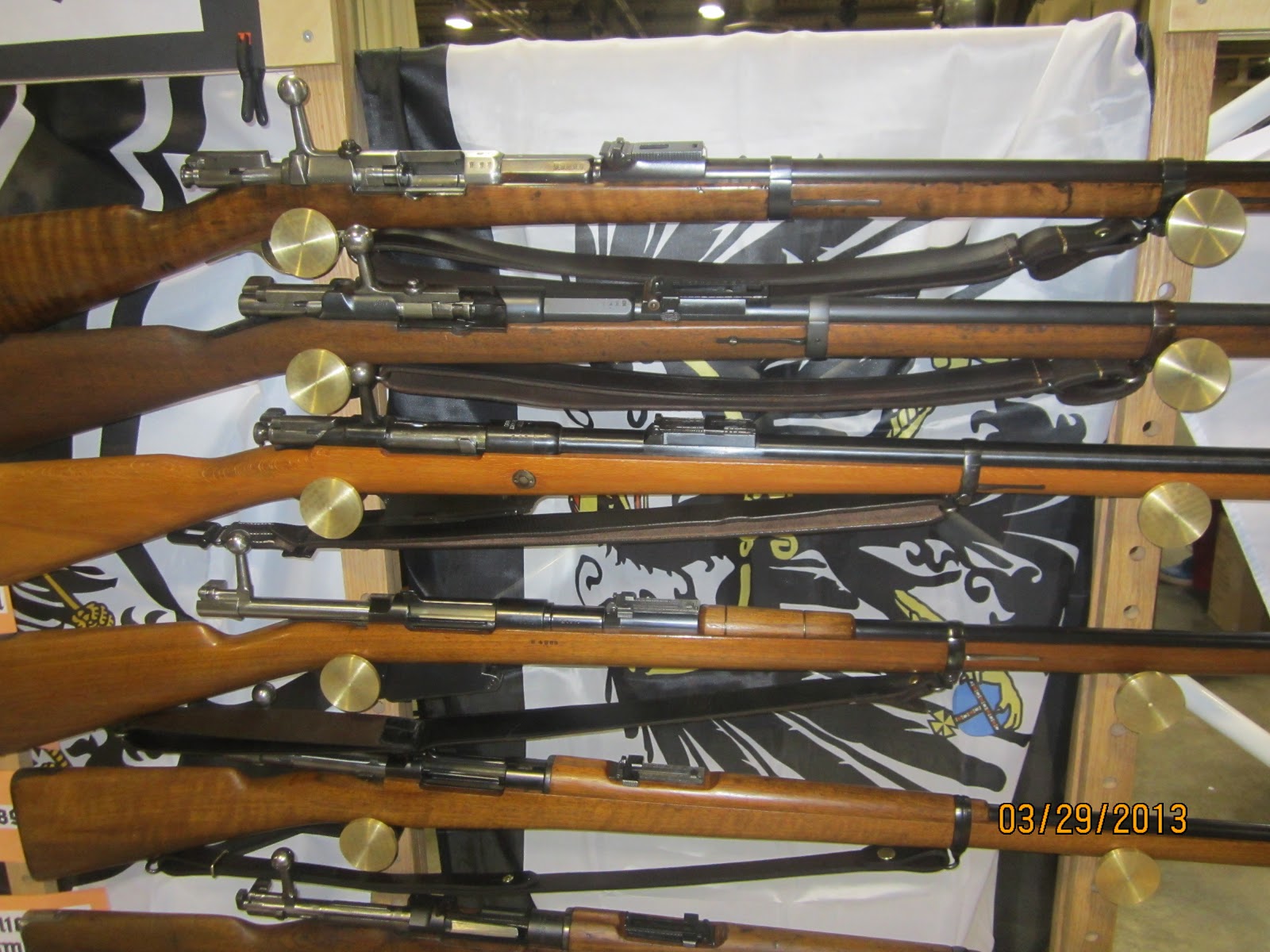
It was a real marathon, seeing everything at the show. Here are a few of the highlights.
A Winchester Model 1876 rifle:
An awesome collection of 19th century Mauser rifles:
A Bren gun:
A Boys anti-tank rifle and a Browning M-2 machine gun:
-Rognar-
Showing posts with label military. Show all posts
Sunday, March 31, 2013
Friday, March 29, 2013
Calgary gun show
So, my buddy J and I went to the Calgary gun show today sponsored by the Alberta Arms and Cartridge Collectors Association. It was the first time for both of us and we were pretty blown away by the size of the show. The selection of firearms, militaria, knives, hunting equipment and general guy stuff was amazing. Being something of a WWII buff, I was particularly keen to pick up a Lee-Enfield rifle, and I lucked out. I got a sweet deal on a 1943 Lee-Enfield No.4 Mk.1 rifle. J was sorely tempted by a mint-condition Garand M-1, but the price tag was pretty steep. He walked away, but I could see the sadness in his eyes. I'll have more pics to show later, but for now, here's a shot of me rocking the Saxon warrior look.
-Rognar-
-Rognar-
Monday, November 26, 2012
Remember when we were awesome? pt.5
Throughout its history, the Royal Canadian Navy has deployed British-designed and built ships, from the HMCS Rainbow, which entered Canadian service in 1910 to HMCS Bonaventure and even today, with our less-than-stellar Victoria-class submarines. However, Canada really began to come into its own during the Cold War, relying less on the UK for military procurement. The first Canadian-designed warship was the St.Laurent-class destroyer escort. Seven were commissioned between 1955-57, HMCS St.Laurent, HMCS Skeena, HMCS Ottawa, HMCS Fraser, HMCS Assiniboine, HMCS Saguenay and HMCS Margaree. Though based on the British Whitby-class frigate, the St.Laurent-class incorporated some distinctly Canadian features, notably the rounded deck edge to prevent ice buildup on the foredeck. The St.Laurent-class ships also included several design features for dealing with nuclear, chemical and biological attack, including sealed crew quarters and a pre-wetting system to wash away contaminants. The later Restigouche-, Mackenzie- and Annapolis-class destroyer escorts were modified versions of the St.Laurent-class design. The seven St.Laurent-class ships underwent DDH conversion in 1963-66, allowing them to take advantage of the newly-developed 'beartrap' helicopter retrieval technology and all were equipped with a CHSS-2 Sea King helicopter. The last St.Laurent-class destroyer escort, HMCS Fraser, was decommissioned in 1994.
-Rognar-
-Rognar-
Monday, November 19, 2012
Remember when we were awesome? pt.4
Canada is, in many ways, a unique country with unique national security concerns. We are in the advantageous position of sharing our only land border with a strong and friendly neighbour, but we have a ridiculous amount of ocean to patrol and a fairly modest population. Furthermore, much of our territory is remote and frozen, so we have few options for land-based military resources to aid in protecting our sovereignty in the far north. Without the option of massive aircraft carriers, nuclear submarines and numerous coastal airbases to patrol our seas, the Canadian navy has been forced to use ingenuity to deal with its security challenges. One example of that ingenuity is the Beartrap, a Helicopter Hauldown and Rapid Securing Device (HHRSD) developed in collaboration with Fairey Aviation of Canada. Designed to allow helicopters to land on small ships in rough seas, the beartrap consists of a heavy winch system that can rapidly pull a cable suspended from the helicopter to haul it down and hold it securely to the landing pad. The helicopter can then be pulled into the hangar and secured. The technology has been refined and is currently used by several other countries, including the United States, Australia, Spain and Japan. As well, all of Canada's larger naval vessels, the three Iroquois-class guided missile destroyers, twelve Halifax-class patrol frigates and two Protecteur-class supply ships are equipped with the technology, giving much needed air support to our modest fleet.
-Rognar-
-Rognar-
Friday, November 16, 2012
Remember when we were awesome? pt.3
At its peak in 1958, Avro Canada was the third largest company in Canada, with about 50,000 employees. It is best known today as the company that designed the Avro CF-105 Arrow, one of the most advanced fighters of its day, intended to achieve speeds in excess of Mach 2 and operate at altitudes exceeding 50,000 ft. Only five were built before the project was cancelled in 1959. All materials and prototypes were destroyed. To this day, many Canadians see the Arrow as Canada's Apollo project and its cancellation still rankles.
The Arrow was not the only audacious design to come from the Avro Canada braintrust. One of the crazier ideas was the VZ-9 Avrocar, a VTOL aircraft designed as part of a classified US military project. Resembling a flying saucer with a single large turborotor in the center, it was hoped the Avrocar would function like a high-performance attack helicopter, but it never performed satisfactorily and was ultimately cancelled in 1961. Only two prototypes were built.
Though not as impressive or cool as the Arrow or the Avrocar, the most successful design to come out of Avro Canada was the CF-100 Canuck, the only Canadian-designed jet fighter to ever reach mass production. First entering service in 1953, 692 CF-100 variants were built. Most were used by the RCAF/CAF, but 53 were purchased for the Belgian air force. Though not as maneuverable or glamourous as Canada's top day fighter at the time, the Canadair Sabre, the Canuck was a solid night and all-weather interceptor and served the Canadian air force well for decades.
-Rognar-
The Arrow was not the only audacious design to come from the Avro Canada braintrust. One of the crazier ideas was the VZ-9 Avrocar, a VTOL aircraft designed as part of a classified US military project. Resembling a flying saucer with a single large turborotor in the center, it was hoped the Avrocar would function like a high-performance attack helicopter, but it never performed satisfactorily and was ultimately cancelled in 1961. Only two prototypes were built.
Though not as impressive or cool as the Arrow or the Avrocar, the most successful design to come out of Avro Canada was the CF-100 Canuck, the only Canadian-designed jet fighter to ever reach mass production. First entering service in 1953, 692 CF-100 variants were built. Most were used by the RCAF/CAF, but 53 were purchased for the Belgian air force. Though not as maneuverable or glamourous as Canada's top day fighter at the time, the Canadair Sabre, the Canuck was a solid night and all-weather interceptor and served the Canadian air force well for decades.
-Rognar-
Thursday, November 15, 2012
Remember when we were awesome? pt.2
Most Canadians have heard of the Avro Arrow, Canada's most famous (or perhaps infamous) foray into advanced military research during the Cold War. Much less well-known, unless, like me, you were born in Halifax in the 1960s, was the HMCS Bras d'Or, Canada's military hydrofoil project. I remember seeing the sleek little ship in the harbour when I was just a wee lad and even though she never got up to speed anywhere within sight of land, she was beautiful. Fifty metres long and displacing 240t, she had a ship's complement of 25. Being an experimental vessel, she was never equipped with armaments. Bras d'Or was built for speed and boy, could she go. Nicknamed the "Flying 400", she reached a maximum foilborne speed in sea trials of 63 knots and was described as highly-stable in rough seas at speeds of up to 40 knots. The project was cancelled in 1971, but the Bras d'Or remains on display at the Musée Maritime du Québec.
-Rognar-
-Rognar-
Remember when we were awesome? pt.1
Does anyone recognize the ship in this picture? It is the HMCS Bonaventure, Canada's last aircraft carrier. I'm betting some of you are surprised to learn Canada ever had any aircraft carriers. In fact, we've had three. In 1946, the RCN took possession of HMCS Warrior from the Royal Navy. In 1948, we gave her back and replaced her with HMCS Magnificent. Finally, in 1957, the Magnificent was decommissioned and replaced with HMCS Bonaventure, which served in the RCN until her decommissioning in 1970.
The "Bonnie" was initially equipped with McDonnell F2H-3 Banshee fighters, as well as Grumman CS2F Tracker aircraft for anti-submarine warfare and Sikorsky HO4S helicopters. In 1962, the Banshees were retired and in 1964, the newer Sikorsky CHSS-2 Sea King helicopters were added. In 1967, she underwent a major refit which included improved radar and upgrades to her 76mm antiaircraft guns. The Bonaventure had a displacement of 16,000t and was 192m in length. She had a crew of 1200 and a top speed of 24.5 knots.
-Rognar-
The "Bonnie" was initially equipped with McDonnell F2H-3 Banshee fighters, as well as Grumman CS2F Tracker aircraft for anti-submarine warfare and Sikorsky HO4S helicopters. In 1962, the Banshees were retired and in 1964, the newer Sikorsky CHSS-2 Sea King helicopters were added. In 1967, she underwent a major refit which included improved radar and upgrades to her 76mm antiaircraft guns. The Bonaventure had a displacement of 16,000t and was 192m in length. She had a crew of 1200 and a top speed of 24.5 knots.
-Rognar-
Subscribe to:
Posts (Atom)